
Do You Still Need a Cookie Banner for Analytics in 2026?
Short answer: for Google Analytics, almost certainly yes. For cookieless analytics, in most cases no, for the analytics itself. The safest practical framing is not "this tool eliminates consent," but "this tool removes analytics as the reason you need consent." The longer answer is worth five minutes, because the banner question is really three separate questions that get mashed together.
(Obligatory and genuine: this is plain-English guidance, not legal advice. Your final compliance position depends on your jurisdiction, your site, and every other tool you run.)
Question 1: What actually triggers the consent requirement?
Two legal layers matter for most sites:
The ePrivacy layer (the "cookie law"): storing or reading anything on a visitor's device that isn't strictly necessary for the service requires prior consent in the EU/UK and similar regimes. GA4 sets identifying cookies (_ga), so it triggers this. The trigger is the storage/access, not the word "cookie"; fingerprinting techniques designed to identify users don't escape it.
The GDPR layer: processing personal data needs a legal basis. IP addresses and persistent identifiers generally count as personal data. Analytics that never stores identifiers and never builds individual profiles has a much easier path here, typically argued under legitimate interest with privacy-preserving, aggregate-only measurement.
So the banner isn't an "analytics tax." It's a consequence of how a given tool measures.
Run ezStats alongside GA4
Cookieless, real-time, with AI traffic as its own channel from day one.
Try ezStats free →Question 2: How do cookieless tools avoid it?
Privacy-first analytics (Plausible, Fathom, Simple Analytics, ezStats) measure differently: no cookies, no localStorage identifiers, no cross-site tracking, and no individual visitor profiles. Counting that a page was viewed, where the visit came from, and aggregate paths through a site doesn't require knowing who the visitor is or recognizing them next week.
That's why the mainstream position, supported by guidance from several European data-protection authorities on audience-measurement exemptions, is that this class of analytics can generally run without an analytics consent banner. Vendors in this category state this position plainly, and the approach is in wide use across EU sites.
The honest hedges, which any trustworthy vendor should give you:
- "In most cases" is doing real work. DPA guidance varies by country, and a few are stricter about any measurement without consent
- The exemption covers the analytics. If your site also runs ad pixels, embedded videos, or chat widgets that set identifying cookies, you still need a banner for those. Removing GA4 removes GA4's banner requirement, not Facebook's
- Features matter, not categories. A "privacy" tool that quietly builds visitor-level profiles is back in consent territory regardless of marketing
Question 3: What does this cost you in data?
Here's the part most banner articles skip: even with a banner, GA4 only measures the people who click accept. Published consent-rate figures vary widely by region, industry, and banner design, but it's common for a meaningful share of visitors, often cited in the 20-40% range, to never opt in, meaning consent-gated analytics silently under-reports, unevenly (privacy-conscious segments vanish entirely). Cookieless analytics measures everyone because it identifies no one. In practice, switching often means your numbers get more complete, not less.
What you genuinely give up without identifiers: user-level retention cohorts, cross-device journeys, and remarketing audiences. If your business depends on those, that's the real reason to keep GA4 (with its banner), not the banner itself.
The 60-second decision tree
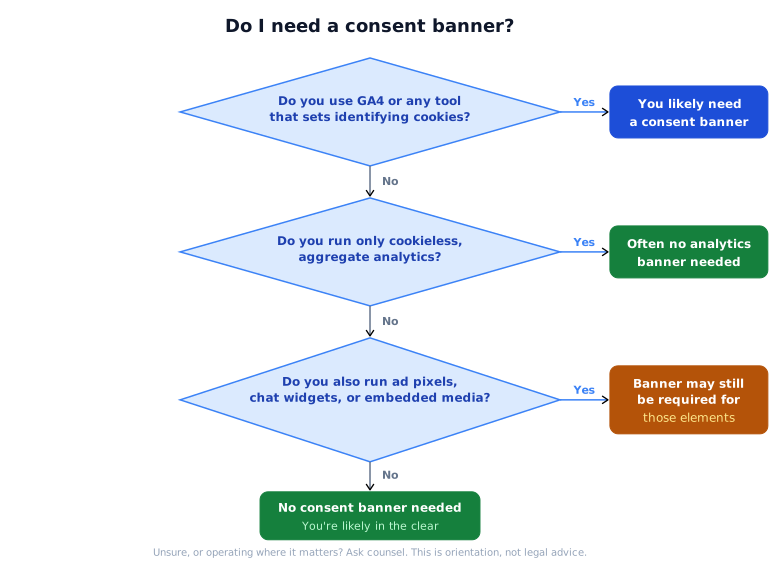
- Do you run GA4 (or any tool setting identifying cookies)? → You likely need a consent banner.
- Do you run only cookieless, aggregate analytics? → Often no analytics banner is needed.
- Do you also run ad pixels, chat widgets, or embedded media? → A banner may still be required for those, independent of analytics.
- Unsure, or operating where it matters? → Ask counsel. This page is orientation, not advice.
Where ezStats lands
ezStats is cookieless, with no cross-site tracking and no individual visitor profiles, so in most cases you can run it without an analytics cookie banner. Our company-identification feature works at the organization level only and never identifies individuals; that line is structural, not a setting. We say "in most cases" on purpose, and we'd be suspicious of any vendor who doesn't.
A practical migration note: teams switching from GA4 typically run both tools in parallel for a week or two; our GA4 migration guide covers the fast path.
FAQ
Does Google Analytics require a cookie banner? In the EU/UK and similar regimes, effectively yes. GA4 sets identifying cookies, which require prior consent under ePrivacy rules, and several European authorities have also challenged GA-style data transfers over the years.
Is cookieless analytics legal without consent? Generally yes for privacy-preserving, aggregate-only measurement with no cookies and no individual profiles, supported by audience-measurement exemption guidance from several data-protection authorities. It varies by country and by tool design, so verify for your jurisdiction.
If I switch to cookieless analytics, can I remove my cookie banner entirely? Only if analytics was the last thing requiring it. Ad pixels, embedded media, and other identifying scripts still need consent. The switch removes the analytics reason for the banner, not every reason.
How much data does a consent banner cost? It varies widely by region and banner design, but published figures commonly put the share of visitors who never opt in around 20-40%, with bias toward losing privacy-conscious segments. Cookieless analytics measures all visitors in aggregate.
Is ezStats GDPR-friendly? ezStats is cookieless, with no cross-site tracking and no individual visitor profiles, and in most cases can be used without an analytics cookie banner. Final compliance depends on your site, jurisdiction, and other tools; check with counsel where it matters.
What do I lose without cookies? User-level retention cohorts, cross-device journey stitching, and remarketing audiences. You keep traffic, sources, content performance, goals, funnels, and (in ezStats) SEO, AI visibility, heatmaps, and organization-level company insights.
Run ezStats alongside GA4
Cookieless, real-time, with AI traffic as its own channel from day one.
Try ezStats free →